

A Faulty System Cannot Consistently Produce Excellent Results

Cracking the Code: Healing Is Not Separate from Systems
Dear Reader,
One of the biggest misconceptions I have encountered is the belief that healing is purely emotional, purely physical, or purely mental. Yet healing does not happen in a silo.
Healing is a system.
The relationship becomes clearer when healing is viewed as a connected progression:
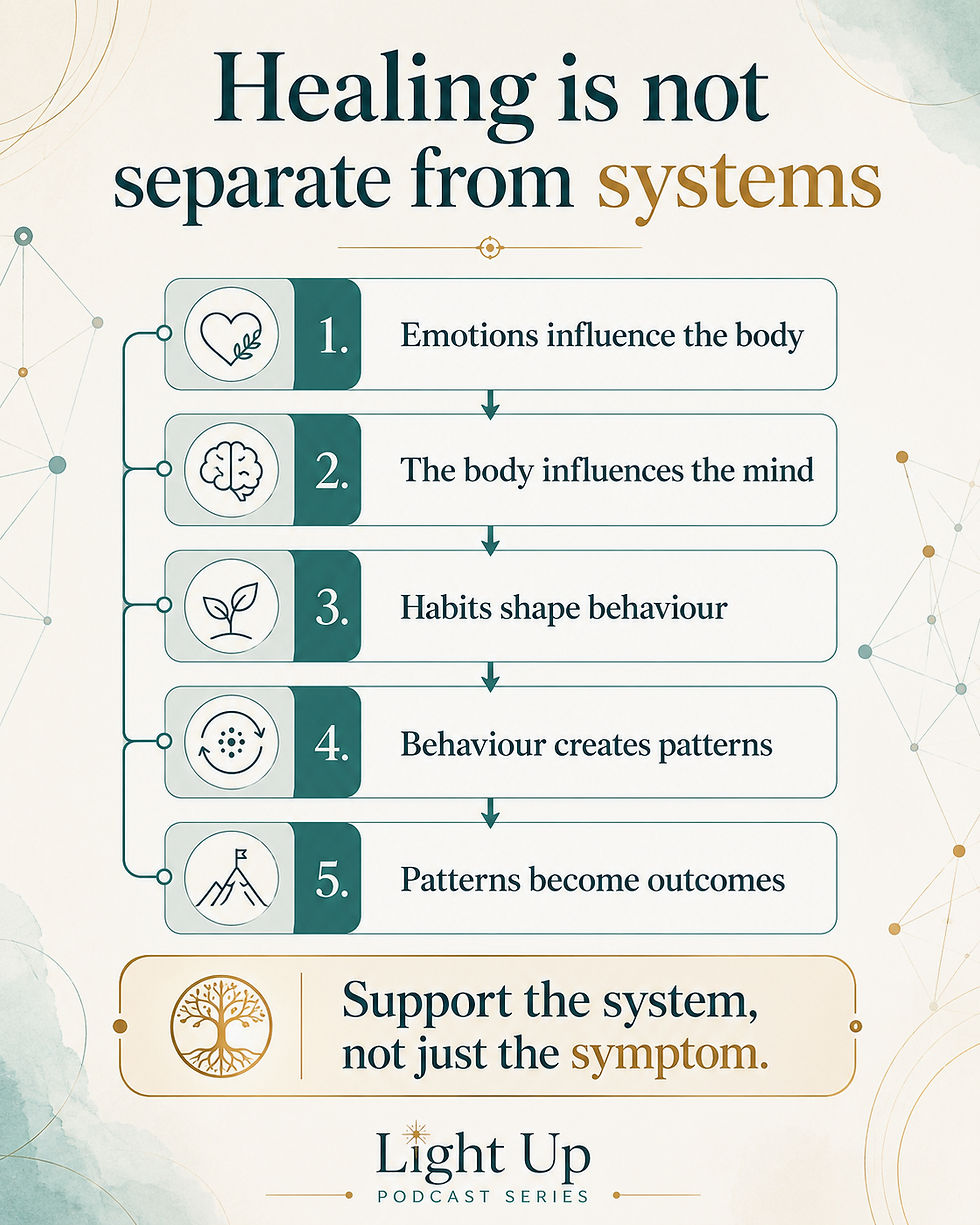
EMOTIONS INFLUENCE THE BODY
Notice what happens when you are stressed, frightened, frustrated, or deeply unhappy. Your shoulders may rise without you realizing it. Your jaw may tighten. Your breathing may become shallow. Your stomach may feel unsettled. You may struggle to sleep, lose your appetite, eat without noticing, or feel exhausted even when you have not done anything physically demanding.
Emotions do not remain contained inside the mind. The body responds to the emotional experience. Sometimes the response is immediate. Your heart races during a difficult conversation. Your hands become cold before an interview. Your chest feels heavy when you receive upsetting news.
Sometimes the response builds gradually. Weeks or months of pressure can begin to appear as constant tension, headaches, disrupted sleep, low energy, difficulty concentrating, or a body that never seems to fully relax.
Not every physical symptom is caused by emotion. Emotions are simply one part of the system influencing how the body functions.
The relationship also works in the other direction. Pain can affect your mood. Exhaustion can reduce your patience. Hunger can make it harder to think clearly. Poor sleep can change how you respond to stress. A body that feels unsafe, depleted, or overwhelmed can shape the emotions you experience.
The body and emotions communicate continuously rather than operating as separate departments. That is why healing cannot focus only on one visible symptom while ignoring the conditions surrounding it.
Healing therefore requires more than treating one visible symptom. The surrounding conditions must also be examined to understand what the entire system is experiencing and what support would allow the system to function differently.
THE BODY INFLUENCES THE MIND
Notice what happens when you are hungry, tired, in pain, or feeling unwell. Your mind may struggle to focus. Simple decisions can feel more difficult. Your patience may become shorter. You may read the same sentence several times without absorbing it, forget what you were about to do, or feel unable to begin a task that would normally seem manageable.
A lack of focus is not always a lack of discipline or motivation. Sometimes the mind is responding to a body that does not have enough energy, rest, comfort, or stability to support clear thinking.
When you are hungry, your attention may keep returning to food because the body is signalling that it needs fuel. When you are exhausted, the mind may become slower because the body is trying to conserve energy. When you are in pain, part of your attention remains occupied by the discomfort, even when you are trying to concentrate on something else. When you are unwell, the body may direct more of its resources toward recovery, leaving less energy available for creativity, decision-making, memory, and focus.
Notice how the same task can feel completely different depending on the condition of the body performing the task. A problem that feels impossible late at night may feel manageable after sleep. A conversation that feels overwhelming when you are hungry may feel less threatening after you have eaten. A decision that seems confusing while you are in pain may become clearer once the discomfort has eased.
Productivity cannot be separated from physical condition. The mind cannot focus properly when the body's basic needs are not being met.
Systems often expect the mind to perform as though the body is irrelevant. People are told they need to concentrate, work harder, stay positive, or push through without asking whether they have slept, eaten, rested, moved, recovered, or felt safe. But the mind does not operate outside the body. The mind depends on the body for energy, regulation, information, and stability.
Supporting the body is therefore part of supporting the mind.
Rest, food, movement, hydration, safety, and recovery all shape the mind’s ability to learn, create, solve problems, and respond thoughtfully.
A mind that cannot focus may not need more pressure. Better physical support may be what the mind needs.
HABITS SHAPE BEHAVIOUR
Many habits begin before a person is old enough to consciously choose them.
Some are formed in childhood while learning how to stay safe, gain approval, avoid conflict, manage uncertainty, or meet the expectations of the surrounding environment. At the time, those habits often serve a purpose by helping a child adapt to the surrounding conditions.
The problem is that habits do not automatically adjust when circumstances change.
A child who learns not to ask for help may become an adult who continues struggling alone, even when support is available. A child who grows up in an unpredictable environment may become highly alert to changes in tone, expression, or mood. A person who is praised for always being productive may learn to ignore hunger, exhaustion, pain, or the need for rest.
The environment may change while the behaviour remains.
Old instructions can continue operating long after they are useful. Examples of internalized messages include:
Do not inconvenience anyone.
Keep going, even when you are tired.
Finish everything before you rest.
Do not speak unless you are certain.
Do not make mistakes.
Take care of everyone else first.
Repeated messages can become habits of thought and behaviour. Over time, they influence how a person works, communicates, eats, sleeps, moves, makes decisions, and responds to stress.
The body can also become conditioned by repetition.
When hunger is repeatedly ignored because there is work to finish, the early signals of needing food may become easier to dismiss. When exhaustion is consistently pushed aside, rest may begin to feel uncomfortable, unproductive, or undeserved. When tension is regularly held in the shoulders, jaw, stomach, or back, that tension may eventually feel normal.
Familiarity is not the same as health.
A habit can feel natural simply because it has been repeated for years. Changing behaviour therefore requires more than telling someone to try harder or make better choices. First, the habit needs to be noticed and its original purpose understood. Only then can someone determine whether the habit still supports their current body, responsibilities, relationships, and environment.
Some habits remain useful.
Some need to be adjusted.
Others need to be replaced entirely.
Becoming an adult does not automatically remove the habits developed during childhood. Without examination, old behaviours can continue shaping present-day outcomes according to circumstances that no longer exist.
What appears to be isolated behaviour is often the visible expression of habits repeated for so long that their influence is no longer noticed.
BEHAVIOUR CREATES PATTERNS
A single behaviour may seem insignificant. Repeated behaviour begins to create a pattern.
Going to bed late once may have little effect. Going to bed late every night can create a pattern of exhaustion, reduced focus, irritability, and dependence on caffeine to function.
Skipping one meal may be accidental. Regularly delaying food until the body is depleted can create a pattern in which hunger is ignored until energy, concentration, and mood begin to decline.
Avoiding one difficult conversation may provide temporary relief. Repeated avoidance can create a pattern in which problems remain unresolved, communication becomes strained, and discomfort increases over time.
Patterns are created through repetition.
The behaviour does not need to be intentional. A person may repeatedly respond in the same way because it feels familiar, produces immediate relief, or once helped them manage a difficult environment.
The short-term result can reinforce the behaviour.
Staying silent may prevent conflict in the moment.
Working through exhaustion may allow a task to be completed.
Ignoring pain may help someone meet a deadline.
Avoiding help may protect a person from feeling vulnerable.
The immediate outcome can make the behaviour appear effective, even when the long-term consequences are harmful.
Patterns become difficult to recognize because each individual action may appear reasonable when viewed on its own. The effect becomes clearer only when the behaviour is repeated across days, months, or years.
A pattern of ignoring exhaustion can lead to chronic depletion.
A pattern of avoiding discomfort can limit growth.
A pattern of accepting poor treatment can make unhealthy environments feel normal.
A pattern of constant urgency can make rest feel unsafe.
A pattern of responding to every problem at the last minute can create a life that always feels unstable.
Patterns also influence the surrounding system.
When one person repeatedly compensates for a broken process, the system may begin depending on that compensation. When employees continually work beyond their capacity, poor planning can remain hidden. When someone consistently places other people’s needs ahead of their own, others may begin expecting that behaviour.
What begins as an individual response can eventually become part of the structure.
Patterns matter because repetition creates predictability. Repeated patterns teach the body, the mind, other people, and entire systems what to expect.
Repeated behaviour becomes evidence of what will likely happen next.
Changing an outcome therefore requires more than addressing one isolated moment. Lasting change depends on identifying the behaviour that keeps repeating and understanding what continues to reinforce the pattern.
A pattern cannot continue without repetition.
When behaviour changes consistently, the pattern can begin to change as well.
PATTERNS BECOME OUTCOMES
Outcomes rarely appear without a history.
What looks like a sudden result is often the accumulation of patterns that have been repeating quietly over time.
A person may suddenly feel exhausted, but the exhaustion may have developed through months of inadequate rest, constant pressure, skipped meals, unresolved stress, and repeated attempts to keep functioning without recovery.
A relationship may appear to break down after one argument, but the outcome may reflect a longer pattern of avoidance, poor communication, unmet needs, or problems that were repeatedly postponed.
A workplace may experience low morale, missed deadlines, high turnover, or declining quality. These outcomes do not usually begin on the day they become visible. They develop through patterns such as unclear expectations, poor planning, limited support, inconsistent leadership, excessive workloads, and a lack of accountability.
The final outcome is often the most visible part of the system, but the visible result does not reveal the whole system.
People tend to respond to outcomes after they appear. Attention is directed toward the missed target, the physical symptom, the damaged relationship, the exhausted employee, or the failed project.
The patterns that produced the outcome may receive far less attention.
Focusing only on the result can lead to repeated attempts to correct the outcome without changing the conditions that produced the outcome.
A person may be told to become more productive without addressing chronic exhaustion.
An employee may be told to improve performance while continuing to work within a faulty process.
A relationship may be expected to improve without changing the patterns of communication inside it.
A health concern may be treated as an isolated problem while the surrounding conditions remain unchanged.
When the underlying patterns continue, similar outcomes are likely to return. Not every outcome can be controlled.
Life includes illness, accidents, uncertainty, and events that no individual or system can fully prevent. Repeated patterns can still influence the probability, direction, and quality of many outcomes.
Patterns of support can produce stability.
Patterns of rest and recovery can improve the body’s ability to function.
Patterns of open communication can build trust.
Patterns of preparation can improve consistency.
Patterns of neglect, urgency, avoidance, or overextension can produce very different results.
An outcome is not always the result of one decision, or even ten decisions. An outcome may reveal a system in which the same habits and behaviours have been reinforced by the same structures, incentives, and conditions over time.
Lasting change therefore requires more than correcting the final result. The underlying patterns and the system producing them must also change.
A faulty system may occasionally produce an excellent result, but it cannot produce excellent results consistently.
BUILDING BETTER SYSTEMS
Outcomes are often judged without examining how the surrounding system was designed.
The same principle appears across every part of life.
An organization with poor communication will struggle to produce excellent work. A city with failing infrastructure will struggle to move people efficiently. A business without a stable foundation from which to operate and grow will struggle to produce and sustain excellent work.
People do not operate outside systems.
When the systems shaping health, relationships, work, or learning continually work against the people inside them, the outcomes will reflect those conditions.
That recognition has made me increasingly interested in building better systems rather than chasing isolated results.
A healthy body, a resilient mind, and a thriving organization depend on supportive systems.
Excellent outcomes rarely appear by accident. They emerge from structures capable of supporting and sustaining them. When a system is faulty, blame is often directed towards the people operating inside the system.
Instead of asking only, “Why did the outcome fail?” a more revealing question may be:
“What kind of outcome was the system structured to produce?”
WHAT SYSTEMS REWARD
A system does not need to deliberately seek a harmful outcome in order to keep producing one.
An organization may claim to value excellence while rewarding speed over quality. Leaders may speak about respect while protecting people who create toxic environments. A workplace may encourage collaboration while promoting those who withhold information, take credit for other people’s work, or undermine their colleagues.
The stated values of a system matter less than the behaviours the system rewards, tolerates, and protects.
Low-quality work does not persist simply because people are incapable of producing something better. Toxic environments do not continue only because someone forgot to address them. Harmful patterns remain when the surrounding structure provides no meaningful reason for those patterns to change.
A system reveals its true priorities through the outcomes it repeatedly allows.
HEALING WITHIN THE SYSTEM
A person may recognize an unhealthy pattern and genuinely want to change, but lasting change becomes difficult when the surrounding system continues rewarding the behaviour that caused the harm.
A workplace may encourage employees to protect their health while praising those who work through exhaustion. A family may say that honesty matters while punishing anyone who speaks openly. A culture may promote self-care while treating rest as laziness and productivity as proof of worth. The stated message supports healing, but the rewarded behaviour supports the old pattern.
Healing therefore requires more than identifying what an individual should do differently.
Systems thinking asks what conditions are shaping the person’s behaviour, what responses are being rewarded, what needs are being ignored, and what consequences make the old pattern difficult to leave.
A person cannot fully recover from constant urgency while remaining inside a system that recreates urgency every day. A body cannot learn that rest is safe when rest is repeatedly followed by guilt, criticism, lost opportunities, or additional pressure. A person cannot build healthier boundaries when every boundary is treated as disobedience, selfishness, or failure.
The individual may be ready to change while the surrounding system continues demanding the same harmful behaviour.
Healing becomes more sustainable when the environment supports the outcome being pursued. Rest must be possible. Safety must be reinforced. Healthy behaviour must be rewarded rather than punished. Harmful patterns must stop receiving protection simply because they are familiar, profitable, convenient, or embedded in the structure.
Systems thinking does not remove personal responsibility. Rather, systems thinking places personal behaviour within the conditions that shape, reinforce, and constrain that behaviour.
A system does not need to consciously want harm in order to keep producing harm.
When exhaustion, silence, fear, low-quality work, poor treatment, or self-neglect continue to be rewarded or tolerated, the system is helping those outcomes persist.
Healing begins with the person, but healing cannot be separated from the system surrounding the person.
Alice


Comments